
FRFP


Item #: OB04007
SKU:
Starting at:
$4,899.00
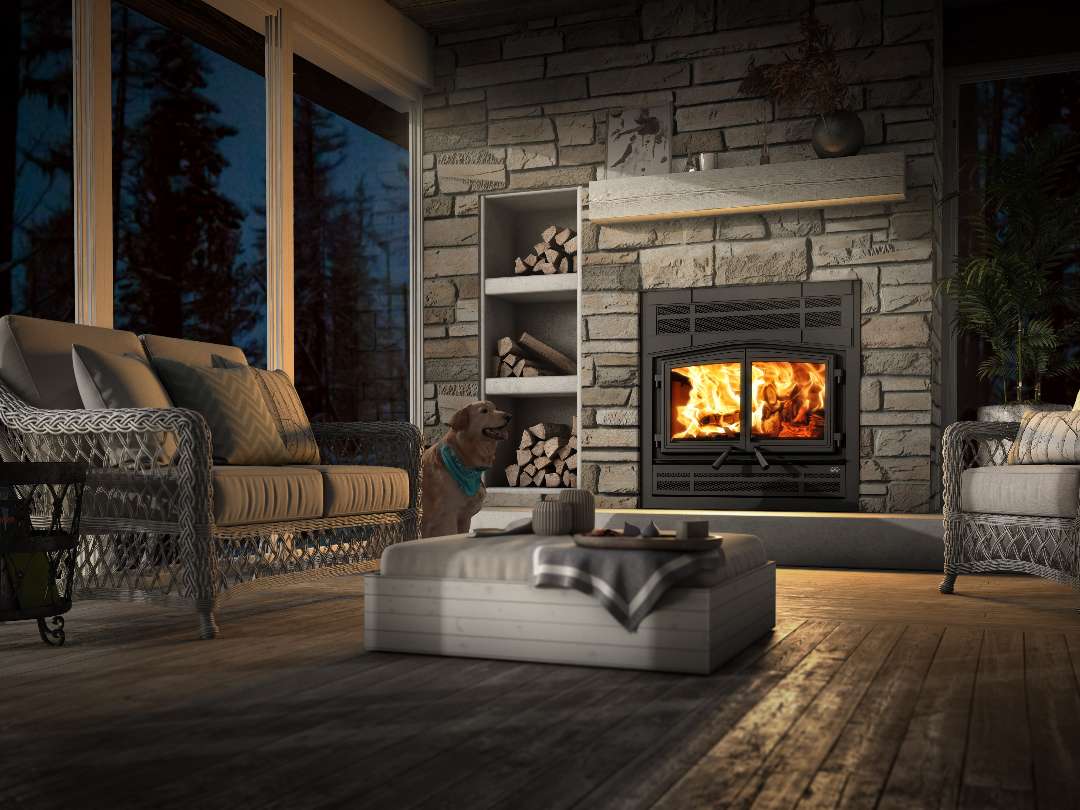
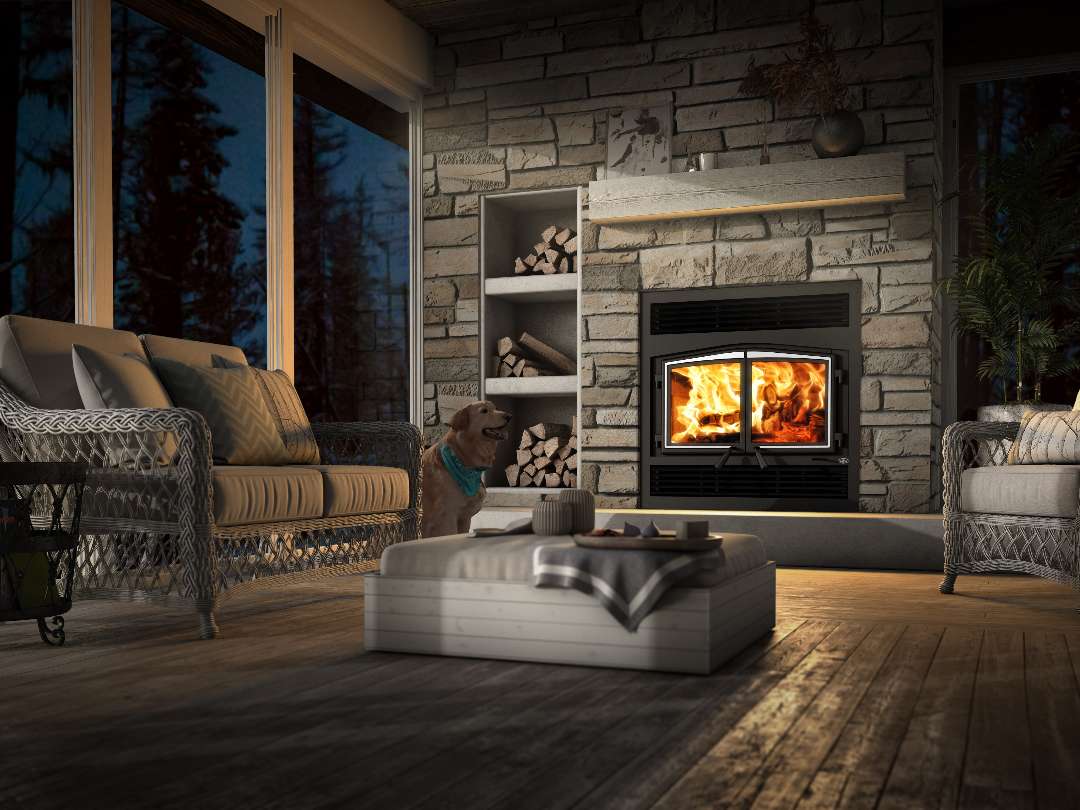
The Stratford II is the one to look at if your emissions number matters or your wall does not have much room. At 1.2 g/h of particulate emissions it burns cleaner than either the Horizon or the Everest III, and it does it in a 36¾"-wide cabinet — a full 14 inches narrower than the Horizon.
That is a real advantage in a retrofit. Many houses have a chase or an alcove that will not take a 50" appliance, and the Stratford II fits where the bigger units simply cannot.
Beyond meeting the EPA's most restrictive standards, cleaner combustion has two practical consequences. It means more of your firewood turns into heat rather than going up the flue as unburned particulate. And it means less creosote in the chimney, which is the fuel source for flue fires and the reason your sweep bills what he bills.
Like the rest of the line it is non-catalytic, so there is no combustor to replace every few seasons. Clean burn comes from firebox geometry and air control.
The firebox is 1.94 cu ft, but the door opening is 25⅝" wide — generous for the cabinet size, and easier to load than the dimensions suggest. Double glass doors in a cast iron frame.
Not sure whether your opening takes the Stratford II or whether you can fit the larger Everest III? Send us the chase dimensions and we will tell you straight — (540) 212-9374.
| Data expressed in inches. 1 inch = 25.4 mm (Single Wall Pipe / Double Wall Pipe) | Single Wall Pipe | Double Wall Pipe |
|---|---|---|
| Clearance - Side Wall | 13" | – |
| Clearance - Top (Measured From the Platform on Which the Appliance Is Installed) | 80" | – |
| Clearance – Minimum Floor Protection in Front of the Appliance | 16" | – |
No video is available.
Q: Why is the efficiency as per the EPA’s test data smaller than the publicized optimum efficiency?
A: EPA refers to the CSAB415.1-10 standard for the calculation of the appliance’s efficiency. The efficiency reported as per EPA’s directives consists of an average between four different burn rates, ranging from the lowest burn rate (air intake completely closed) to the highest burn rate (air intake completely open). The optimum efficiency that we publicize is the efficiency obtained according to the same test data, but for the low burn rate only. This efficiency is more realistic for a majority of users whose heating needs require that the unit be used to maximize burn times.
Q: Why is the BTU according to EPA test data smaller than the one advertised?
A: You will notice a difference between the BTU output as per the EPA’s test data and what is advertised on our web site and/or product literature. The maximum BTU output we advertise is what will be obtained with a full load of seasoned cordwood inserted inside the firebox. The EPA output, on the other hand, is what has been obtained during emissions testing. The EPA test procedure requires that a special type of wood is used and positioned inside the firebox in a manner that does not represent the way the firebox volume would normally be utilized using seasoned cordwood. The EPA test load is typically much smaller. Hence, the BTU as per the EPA’s test data is reduced. The BTU output that should be considered by a normal user is the one we advertise for seasoned cordwood.
Q: Can I install an EPA or CSAB415.1-10 certified heater on an 8-inch chimney?
A: EPA or CSAB415.1-10 certified heaters function best on a 6-inch chimney (interior diameter). The problem with an 8-inch chimney is that the appliance may struggle to heat-up the air volume contained inside the chimney. A hot chimney is required to create enough draft. Poor draft will inevitably lead to poor combustion, which will cause smoke roll backs, a dirty glass, lack of heat, and a large quantity of unburned fuel inside the firebox. It is therefore highly recommended installing a 6-inch liner inside the 8-inch chimney. This liner may be rigid or flexible.
Q: Do I need to install a fresh air intake on my wood heater?
A: A fresh air intake is not mandatory for your wood heater, unless the unit is installed in a mobile home or if the local building code or the manufacturer requires it. If the heater is installed in an open room, in a house that is more or less air-tight, combustion air will normally be easily replaced. In this case, the installation of a fresh air intake is not required. It must, however, be noted that a fresh air intake, even if it is not mandatory, will always provide the advantage of better balancing the house with regards to combustion air. If the house has a powerful mechanical exhaust system that may be used while the heater is burning (ex: range hood), a fresh-air intake will be required.
Q: How much heat transfer should I get from my fireplace using a forced air kit?
A: Several factors can affect the amount of heat transferred to your rooms through a forced air option. The length of the system, the deviations and the insulation of the conduits can have a major impact. It is recommended to use a short system with few deviations. The heat transfer will be optimized when your fireplace is hot. Heat transfer too soon when the fireplace has not reached its optimum combustion temperature can cool the combustion chamber too quickly and cause poor combustion. An overpowered fan can also lead to the same negative effects. The ideal situation is a lower but constant air flow when the fireplace is hot. We can therefore expect to transfer at least 25% of the heat from the appliance to other rooms. It should be noted that the systems sold with your fireplace have been tested for safety by the appliance manufacturer. If you do not use the original system supplied by the manufacturer, you expose yourself to a risk of fire. If in doubt, consult a professional installer.
© 2026 First Response Fireplace Products, All rights reserved
